Is Kimi K3 Open Source? Weights, License, and How to Call It
OpenRouter ·
Kimi K3 is open-weight, not open-source. Moonshot AI published the checkpoint on Hugging Face as moonshotai/Kimi-K3 under the Kimi K3 License, a custom license that has no SPDX identifier and is not on the Open Source Initiative approved list. The Hugging Face model card sets the license field to other with the name kimi-k3. If you want to call the model through an API instead of running the weights yourself, we serve it as moonshotai/kimi-k3.
This post covers what the license grants and requires, what the checkpoint contains, and how to call the model on OpenRouter.
Summary
- Kimi K3 is open-weight. The weights are public, but the Kimi K3 License is Moonshot AI’s own text and is not OSI-approved.
- The license grants use, modification, distribution, and sale by default. It adds two conditions at scale, a Model as a Service revenue gate and a user-interface attribution requirement.
- The checkpoint is a 2.8 trillion parameter mixture-of-experts model with 104 billion active parameters per token, stored in MXFP4.
- On OpenRouter the model ID is
moonshotai/kimi-k3. It accepts text, image, and video input, has a 1,048,576-token context window, and supports reasoning effort, tool calling, and structured outputs. There is no:freevariant.
Open-weight versus open-source
The two terms answer different questions.
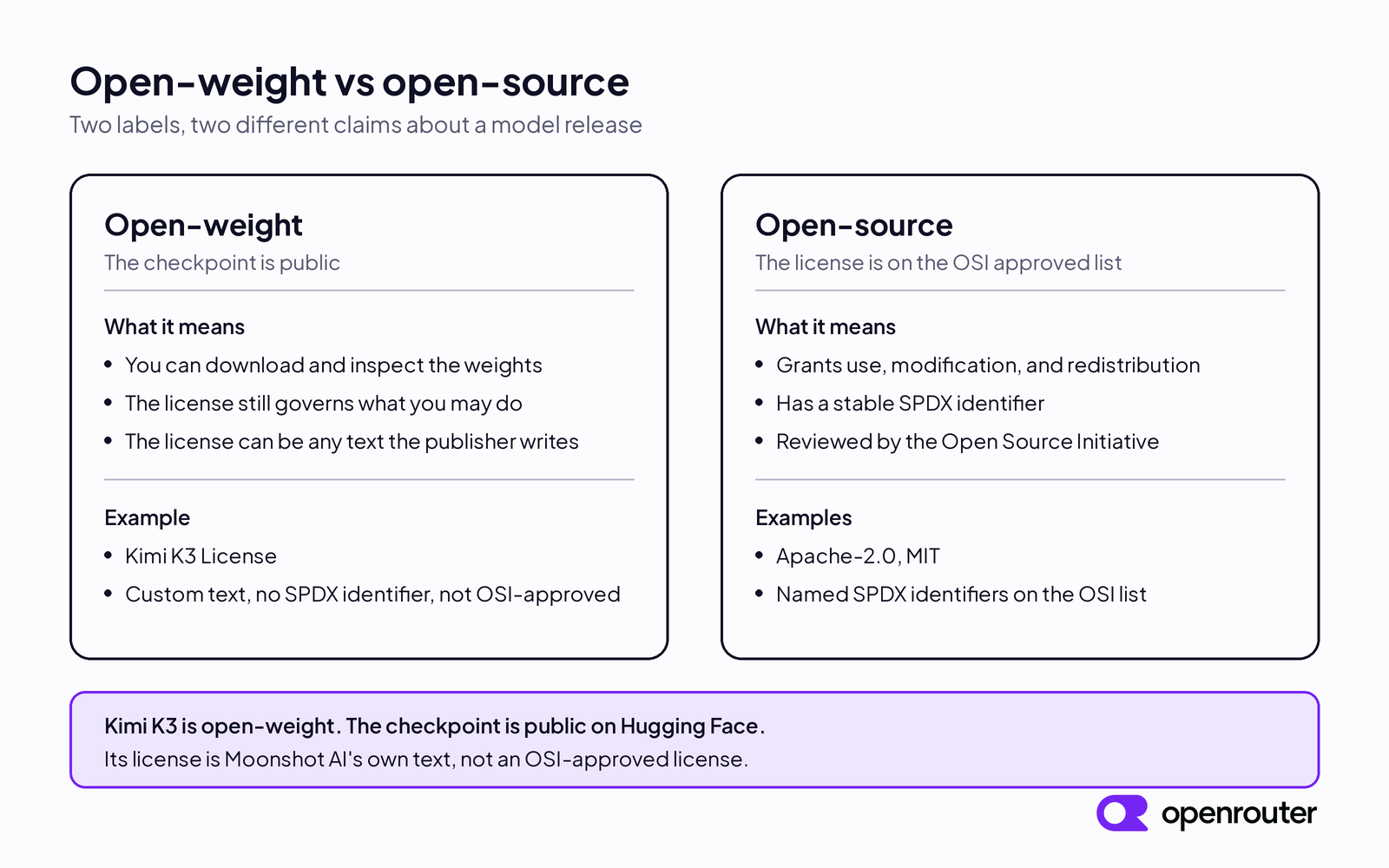
Open-weight means the publisher released the trained parameters so you can download and inspect them. The license attached to those parameters can be any text the publisher writes.
Open-source, as the Open Source Initiative uses the term, means the license meets the Open Source Definition and appears on the OSI approved list. Licenses like Apache-2.0 and MIT have SPDX identifiers and are on that list.
Kimi K3 meets the first definition and not the second.
What the Kimi K3 License grants
The license text defines the software as the model weights, parameters, configuration files, inference and training code, and associated documentation. It grants, free of charge, the rights to use, copy, modify, merge, publish, distribute, sublicense, and sell copies of the software, and to run, deploy, fine-tune, and create derivative works from it.
Section 1 sets two baseline conditions. You must include the copyright notice and the permission notice in all copies or substantial portions of the software, and your use must comply with applicable laws and regulations.
What the Kimi K3 License requires at scale
Two further conditions apply above specific thresholds.
Model as a Service gate. Section 2 defines Model as a Service as giving a third party access to language model inference or fine-tuning, for example through an API, in a way that lets the third party exercise meaningful control over the inputs, parameters, or training data. The definition excludes end-user products where model capabilities are embedded within specific features or harnesses, and it excludes relaying requests to models hosted by others. If you or any of your affiliates operate a Model as a Service business, and your aggregate revenue exceeds 20 million US dollars over any consecutive 12 months, you must enter into a separate agreement with Moonshot AI before using the software or its derivatives for any commercial purpose.
User-interface attribution. Section 3 applies when the software or a derivative is used in a commercial product or service with more than 100 million monthly active users or more than 20 million US dollars in monthly revenue. In that case the product must prominently display “Kimi K3” on its user interface.
Exemptions. Section 4 exempts two cases from both conditions. The first is internal use, defined as use that does not make the software, its outputs, or its underlying capabilities available to third parties. The second is access through Moonshot AI’s official products or certified inference partners.
Section 5 is the warranty disclaimer. The software and its outputs are provided as is, without warranty of any kind.
Read the license before you ship a product built on the weights. This post describes the text as published on 2026-09-11 and is not legal advice.
What the checkpoint contains
The figures below are from the Hugging Face model card.
| Fact | Value |
|---|---|
| Total parameters | 2.8T |
| Activated parameters per token | 104B |
| Experts | 896 total, 16 activated per token |
| Attention | Kimi Delta Attention and Attention Residuals |
| Vision encoder | MoonViT-V2, 401M parameters |
| Context length | 1,048,576 tokens |
| Weight format | MXFP4 weights, MXFP8 activations, quantization-aware trained |
| License | Kimi K3 License |
| Hugging Face repository | moonshotai/Kimi-K3 |
The model card describes Kimi K3 as a native multimodal model that understands text, images, and video. It lists thinking as always enabled, with a reasoning_effort field that accepts low, high, and max, defaulting to max. For multi-turn conversations and tool calls, the card states that the complete assistant message returned by the API, including reasoning content and tool calls, must be passed back in messages.
The card lists three local serving stacks with published recipes, vLLM, SGLang, and TokenSpeed. We have not benchmarked these stacks and this post does not cover self-hosting. A 2.8 trillion parameter checkpoint requires multi-node serving hardware. If you do not have that hardware, a hosted API is the way to run the model.
How to call Kimi K3 on OpenRouter
The model ID is moonshotai/kimi-k3. The catalog record on 2026-09-11 listed these properties.
| Property | Value |
|---|---|
| Input modalities | text, image, video |
| Output modality | text |
| Context length | 1,048,576 tokens |
| Reasoning | enabled by default, efforts low, high, max, default max |
| Supported parameters | tools, tool_choice, response_format, structured_outputs, reasoning, reasoning_effort, include_reasoning, max_tokens, temperature, top_p, top_k, seed, stop, logprobs, top_logprobs, logit_bias, frequency_penalty, presence_penalty, repetition_penalty, min_p |
| Variants | moonshotai/kimi-k3:batch for the Batch API. No :free variant. |
Pricing
We do not set one price for the model. Each provider endpoint lists its own prompt, completion, and cache-read price, and the model page shows the current table. On 2026-09-11 the catalog had 19 endpoints for moonshotai/kimi-k3. Prompt prices ranged from $1.80 to $6.00 per million tokens, completion prices from $9.01 to $22.50 per million tokens, and cache-read prices from $0.21 to $0.60 per million tokens. Moonshot AI’s own endpoint listed $3.00 prompt, $15.00 completion, and $0.30 cache read. Maximum output length also varied by endpoint, from 16,384 tokens to 943,718 tokens.
Provider endpoints also differ in which parameters they support. On 2026-09-11, two endpoints did not list tools and two did not list structured_outputs. If your request depends on a parameter, set provider.require_parameters to true so we only route to endpoints that support every parameter in the request. See provider selection for the full set of routing controls.
Reasoning
Kimi K3 returns reasoning by default. Through our API you control it with the reasoning object. reasoning.effort accepts low, high, and max for this model. reasoning.exclude set to true removes the reasoning text from the response while the model still reasons. reasoning.enabled set to false asks the endpoint to skip reasoning.
We ran each configuration once against moonshotai/kimi-k3 on 2026-09-11 with a short arithmetic prompt. The default, low, and max requests each returned a reasoning field and one reasoning_details entry with the answer. The exclude request returned the answer with no reasoning fields. The enabled: false request returned no reasoning fields and a longer answer that showed its working in the content field. The model card says thinking is always enabled, and a single call cannot show whether the endpoint stopped internal reasoning or only stopped returning it. Treat enabled: false as a request to the endpoint, not a guarantee.
For multi-turn conversations and tool calls, pass the complete assistant message back in messages, including reasoning_details and tool_calls. Our reasoning guide covers preserving reasoning across turns.
Example request with an image
This request sends an image and a question, asks for high reasoning effort, and prints the answer. It uses the TypeScript SDK.
import { OpenRouter } from '@openrouter/sdk';

const openRouter = new OpenRouter({
  apiKey: process.env.OPENROUTER_API_KEY ?? '',
});

const result = await openRouter.chat.send({
  chatRequest: {
    model: 'moonshotai/kimi-k3',
    messages: [
      {
        role: 'user',
        content: [
          {
            type: 'image_url',
            imageUrl: { url: 'https://example.com/screenshot.png' },
          },
          {
            type: 'text',
            text: 'Summarize this screenshot and list the open questions.',
          },
        ],
      },
    ],
    reasoning: {
      effort: 'high',
    },
    stream: false,
  },
});

if (result instanceof ReadableStream) {
  throw new Error('Expected a non-streaming response');
}

console.log(result.choices[0].message.content);
We ran an equivalent request with a public photograph on 2026-09-11. The endpoint returned a one-sentence description of the image, a reasoning field, and a usage object with 96 prompt tokens, 119 completion tokens, and 87 reasoning tokens. Image input is covered in image understanding and video input in video input.
Tool calling and structured outputs
The model record lists tools, tool_choice, response_format, and structured_outputs. Tool definitions follow the shape in tool calling. JSON Schema responses follow structured outputs. Because support for these parameters varies by endpoint, set provider.require_parameters to true when the request depends on them.
Prompt caching
Every moonshotai/kimi-k3 endpoint on 2026-09-11 listed a cache-read price. When a request hits the provider’s prompt cache, the cached prompt tokens are billed at that endpoint’s cache-read rate rather than its prompt rate, and the response reports them in usage.prompt_tokens_details.cached_tokens. See prompt caching for how caching works per provider.
Earlier Kimi releases
Kimi K2 and Kimi K2.5 use a modified MIT license. Each adds one clause to MIT that requires commercial products with more than 100 million monthly active users or more than 20 million US dollars in monthly revenue to prominently display the model name on the user interface. The Kimi K3 License keeps that attribution clause and adds the Model as a Service revenue gate.
Our catalog also lists moonshotai/kimi-k2.6, moonshotai/kimi-k2.7-code, moonshotai/kimi-k2.5, moonshotai/kimi-k2-thinking, and moonshotai/kimi-k2. This post covers Kimi K3 only.
FAQ
Is Kimi K3 open source?
No. Kimi K3 is open-weight. Moonshot AI published the weights on Hugging Face under the Kimi K3 License, a custom license that is not on the Open Source Initiative approved list. The license grants broad rights to use, modify, distribute, and sell the model, with two conditions that apply at revenue and user-count thresholds.
What does the Kimi K3 License allow?
The license grants the rights to use, copy, modify, merge, publish, distribute, sublicense, and sell copies of the model, and to run, deploy, fine-tune, and create derivative works. You must keep the copyright and permission notices in copies of the software and comply with applicable law.
What conditions does the Kimi K3 License add?
Two. If you or your affiliates operate a Model as a Service business and your aggregate revenue exceeds 20 million US dollars over any consecutive 12 months, you need a separate agreement with Moonshot AI before commercial use. If a commercial product built on the model has more than 100 million monthly active users or more than 20 million US dollars in monthly revenue, its user interface must prominently display Kimi K3. Internal use and access through Moonshot AI’s official products or certified inference partners are exempt from both.
Can I download the Kimi K3 weights?
Yes. The checkpoint is published at moonshotai/Kimi-K3 on Hugging Face. It is a 2.8 trillion parameter mixture-of-experts model stored in MXFP4, with 104 billion parameters active per token.
How do I call Kimi K3 on OpenRouter?
Send a chat completion request to https://openrouter.ai/api/v1/chat/completions with the model ID moonshotai/kimi-k3. The endpoint accepts text, image, and video input, returns text, and supports the reasoning, tools, and structured output parameters.
Is there a free variant of Kimi K3 on OpenRouter?
No. The catalog lists moonshotai/kimi-k3 and a separate moonshotai/kimi-k3:batch entry for the Batch API. Neither is free. Pricing is set per provider, so check the model page for the current rates.